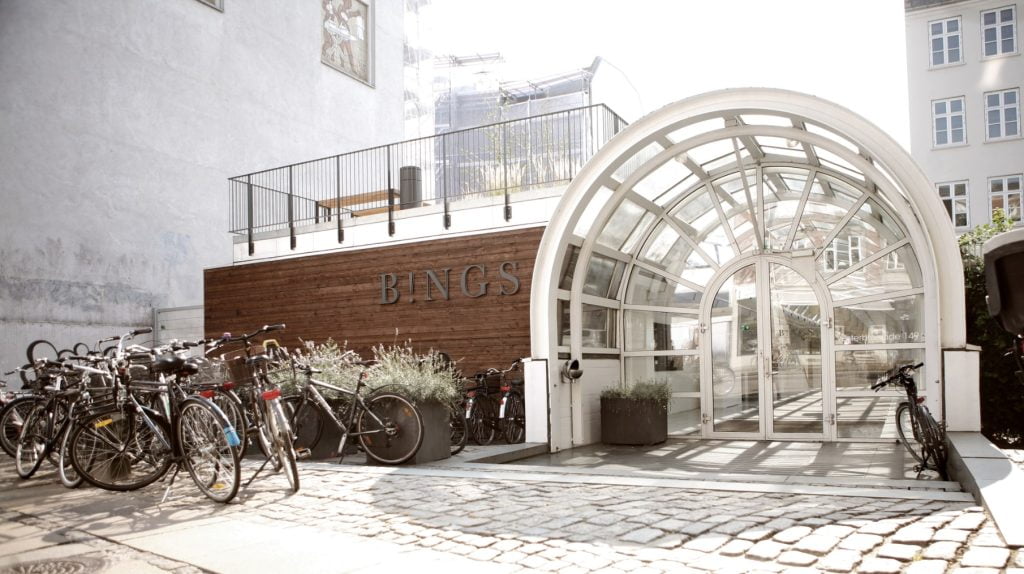
This year, the ETN Symposium will be held at B!NGS Copenhagen 13-15 October 2026. You're invited to join us for three days of exciting tracking science, in-depth conversations on where to go next, and networking with some of the world's best tracking scientists. One day will be dedicated to recounting tales of the STRAITS project, and we're excited to tell you about the waves this project has made. In addition, this year, the symposium has organized six thematic sessions (see below) to which you can submit for a presentation and/or poster. Your talk doesn't quite fit into these sessions? No worries, we have an "Open tracking session" as well.
You can find the schedule for the event here.
You can find the Book of Abstracts here.
Hosts: Kim Birnie-Gauvin & DTU (feel free to contact Kim should you have any questions)
When: 13 October 2026 9.00 to 15 October 2026 17.00.
Where: B!NGS Copenhagen (Vesterbrogade 149, Copenhagen, Denmark)
Copenhagen is an easy city to get around: walking, biking, trains... The Copenhagen Central Station (København H) is a hub where you can catch regional trains, metros, and buses.
Getting to the city from the airport: the easiest is by far the regional train. Follow the instructions inside the airport arrivals terminal. You can buy tickets at the little kiosks, then follow the stairs down. The train should be heading in the direction of "Køvenhavn H". The cost is around 30DKK.
Getting to the conference from the Central Station:
Metro: you can take the M3 and get off at Frederiksberg Alle. From there, you have a short walk (500m) to the conference. Buy tickets at the kiosks in the station, or via the DSB app.
Walking: it's a 2km walk from the Central Station to the conference. Your hotel may even be closer and we strongly encourage some fresh air!
The ETN symposium does not have a deal for any hotels nearby, but Copenhagen has plenty to choose from.
Options near the conference centre:
CityHub is well-rated, VERY affordable and a quick stroll away from the conference.
Hotel Sct. Thomas is more expensive, but also nearby.
Coco Hotel is cute and cozy!
Slightly further options, but closer to the main hub of the city (restaurants, activities):
Areas to avoid: areas sometimes avoided or deemed less comfortable at night include parts of Tingbjerg, Nordvest, and Nørrebro (specifically around Mjølnerparken). That being said, Copenhagen is considered a very safe city!
ORAL PRESENTATION: If you are giving an oral presentation, you will have a total of 10 minutes, including time for questions. Our suggestion is a talk of 7-8 minutes, and 2-3 minutes of questions. We will be strict on this. We also realize this is a short time, but this was in the interest of having as many talks as possible given the incredible number of registrations we received. Please have your talk on a USB key, and bring it to the front computer during a coffee break (or in the morning before the symposium starts), at least one session ahead of your own.
POSTER PRESENTATION: A0 poster, in the vertical direction are preferred.
Thematic Sessions
Session 1: Little do we know: tracking unknown and overlooked species
Our aquatic ecosystems are so diverse, yet so little is known about so many species. Be it for lack of funding or lack of interest, some species have just been overlooked. It’s time we give them the spotlight.
Organiser(s): KIm Birnie-Gauvin
Session 2: Tracking rays and skates across European waters
Rays and skates are among the most emblematic fish groups. While many species are currently classified as threatened, others remain commercially important and subject to conservation or management measures. Despite their ecological relevance, rays and skates have long been underrepresented in telemetry research. This session aims to showcase current tracking studies across Europe, highlighting the diversity of species, environments, methodologies, and emerging insights into their spatial ecology and behaviour.
Organiser(s): David Abecasis & David Villegas-Rios
Session 3: Novel methods, techniques and interoperability in acoustic telemetry
This session invites communications presenting novel methods, techniques and technological advances that enhance the extraction of biological information from acoustic telemetry data. We particularly welcome contributions addressing the analysis of large and heterogeneous datasets, the transformation of detections or presence–absence data into meaningful temporal and spatial traits, behavioural segmentation and inference (including AI-based approaches), advances in hardware and software, and issues of interoperability, including the performance, limitations and implementation of the ETN Open Protocol. The session aims to foster cross-system methodological innovation and promote scalable, reproducible and interoperable solutions for next-generation acoustic telemetry research.
Organiser(s): Josep Alos
Session 4: Regional-scale, rare and pilot acoustic tracking in applied research
Large-scale telemetry networks are built upon the success of local and regional initiatives, which often generate unique and hard-won datasets that are critical for applied research but remain unpublished or confined to grey literature due to limited sample sizes, logistical constraints or the exploratory nature of the work. This session invites contributions presenting regional-scale, rare or pilot acoustic tracking studies that provide valuable ecological, methodological or management insights despite inherent limitations in replication or statistical power. We particularly encourage communications on tracking experiments in deep or remote environments, pelagic and open-water systems, highly anthropogenic or risk-prone habitats, critical or poorly accessible habitats, and studies on rare or endangered species, as well as pilot deployments testing novel environments or approaches.
Organiser(s): Josep Alos
Session 5: From data to Digital Twins: pipelines, centralisation and more
Digital Twin (DT) frameworks have truly taken off in the last few years. DTs were originally not developed for the purposes of "twinning" animal movement, and yet we know that these movements are key biological variables for ecosystems. We also know that building these DTs based on animal movements requires data centralisation, pipelines, and so much more. This session invites contributions on everything related to Digital Twins within the context of animal movement.
Organiser(s): Pieterjan Verhelst & Jan Reubens
Session 6: From insights to impact: how telemetry results find their way into policy
Ensuring that valuable insights from telemetry find their way into policy can be a long and windy road. Many tracking projects aspire to contribute their results to decision making processes either through data integration into existing databases and ecological models, or through insight communication via management collaboration and policy briefs. Results from these efforts are not often shared or discussed while they are highly relevant for the tracking community to support uptake. This session welcomes communications presenting their experiences on integration and communication of insights from telemetry studies to support policy decisions. By sharing both successful and less successful experiences, challenges and lessons learned, this session aims to open up new roads within ETN for researcher and telemetry results to find their way into the decision-making processes.
Organiser(s): Inge van der Knaap
The ETN Symposium 2026 is supported by the STRAITS project. This project has received funding from the European Union’s Horizon Europe research and innovation programme under grant agreement No. 101094649. Views and opinions expressed are however those of the author(s) only and do not necessarily reflect those of the European Union. The European Union cannot be held responsible for them.